Practical Work-from-Home Advice from a Veteran

The global pandemic has hit us hard, disrupting our personal and work lives equally. In times like these, the pressure of keeping our family safe is already daunting enough and the added responsibility of making sure our work productivity doesn’t go down is not make things easy. My heart goes out to thousands of workers whose jobs went under the axe or who had to find alternative work arrangements to sustain their families. Many of us had to rethink our daily working lifestyles to accommodate kids who can’t go to schools and daycares now. A sudden change in working style is not an easy adaptation and social media is abuzz with people struggling to cope with this change. I have been a work-from-home (WFH) guy for over a year now and learnt a few things in my journey that I believe would be valuable to some people who find themselves working from home now. Things that worked for me might not work for everyone but these are some ideas that can give you an alternative to the popular narrative going around.

  • Choose your style of working – A lot of influencers are suggesting that you closely follow the same schedule and lifestyle that you used to follow before the shift. That means you keep your sleep schedule, work style and personal time the same as before. I, on the other hand, feel that a different working arrangement requires a modification to your lifestyle. I tried to stick to my office schedule after making a shift to WFH, but found it to be wasteful in a lot of aspects. WFH means that I don’t travel to office anymore and don’t have to get up at 6am to make it for the 8am stand up meeting. I can afford to sleep late in the nights and still make it to the virtual call on time. After failing to stick to my old office schedule, I realized that I am a person who likes to work at nights and do not see any drop in productivity while working late into the night. Unnecessarily sticking to my office schedule wasted my hours planning and preparing for the next day when I could have finished a new skill course and gained some hands on experience. The additional hours in the morning is now used to catch up on sleep and I am on my desktop within minutes of getting out of bed. Breakfast takes 10 min to prepare between work and I usually have it on my desk while catching up with the daily mails.

People with kids, now that kids are not going to their day cares, also have the option of working late in the night, after spending additional hours with family and putting their kids to sleep.  Don’t get me wrong, I am not professing that every pull all-nighters but a careful examination of your working style and choosing a schedule that maximizes your output through the day is not a bad idea in my books.

  • Get a permanent working spot for office work – This would apply to most people who have tight delivery timelines and have other team members depending on their output. Having a dedicated office space really helps you get into the ‘working zone’ and block out everything else. An office space doesn’t really need to be a dedicated room with office furniture. I used a corner of my living room with a desk and a comfortable chair as my office space for a very long time. Let me emphasize how important a comfortable chair is to pulling off an 8-hours work. So invest in a good chair, it is going to last you a long time.

For any personal work like an online course or a personal project, I have seen that moving away from the dedicated office space helps me change my mood and allows me to disconnect. Spending a couple of hours on an online course in the comfort of my couch doesn’t burden my psyche with the additional hours.

  • Exercise – I cannot emphasize enough how important I found exercise to be in my WFH schedule. After a few weeks of WFH, I found myself constantly tired despite not even having stepped out at all. I was feeling bored, lethargic and demotivated after an 8 hour shift in front of the computer. It was eventually out of boredom that I decided to go swimming and found that I had a much better temperament and energy levels. Since most community gyms and sports complex are not working right now, my suggestion is to dust off that treadmill or exercise cycle and burn some calories. If you don’t have one, fret not. There are umpteen number of online tutorials to help you unwind with no equipment and limited space. Yoga, dancing and anything under the roof that gets your heart beating faster will do as long as you take care to not disturb others while doing do.
  • Lastly, break the monotony – A few days to work from home might not require a whole lot of planning and seems like a respite from the daily hustle bustle but a long term stint from home will soon start punching you down. To break the monotony, I have been trying my hands at several things including but not limited to cooking and digital painting. None of these activities add to my professional skill set but they offer me an out from the mundane bedroom-office-TV-bedroom routine. My family has been enjoying a good game of Uno or Ludo every night and you wouldn’t believe me when I tell you that it is the most looked forward to event in the day. The family gets good laughs over silly jokes it melts away the monotony after a seemingly long day.

The current situation is not going to last very long but it is important that we maintain our resolve and motivation levels so that we do not burn out by the time all this is over. I hope you find some ideas that help you create your own style of managing the new business environment that we find ourselves in.
Why is now the best time to be an entrepreneur?

New Year brings with it the usual optimism in me and despite having fared abysmally at my previous years’ resolutions, I have yet again made some new ones. While the world is seemingly embroiled in numerous conflicts and serious skirmishes, I still consider today’s world to be better than yesterdays. While the highlight of my parent’s generation was the cold war, I think one of the most defining and complex issues of my generation is the never-ending war in the middle-east, some of the less serious ones being TicTok and insufficient battery capacity of modern phones, but more on those later. None of these seem to even come close to what the world lost in the two world wars and numerous plagues and famines before them. So, my vote is with Steven Pinker when he argues that we are doing considerably better than our forefathers. In the same spirit, let me try and convince you that the best time to be an entrepreneur is now.

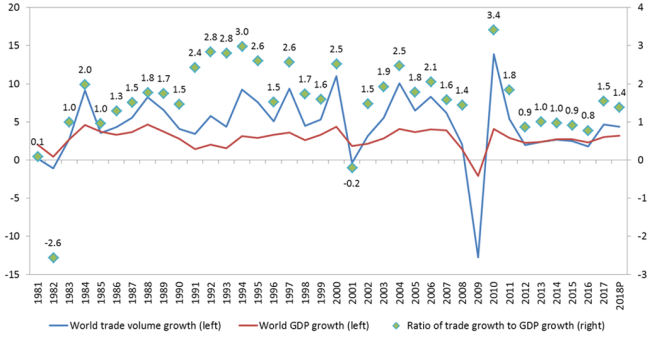
Unprecedented levels of trade between nations – A simple way to prove this is with official data. Let me start with that then.

World Trade

Fig. 1 percentage change and ratio
Source – WTO and UNCTAD

World trade organization’s data shows a consistent positive growth rate of world’s trade volume. As an inference, we can confidently say that since countries are exchanging goods and services more readily, there is a bigger market for anything that today’s entrepreneurs produce than there was ever available.

Maturing technology and internet services – The pace of technology development in the last decade has brought us to the point that it is possible to design and offer products and services that were only science fiction material in the late 90’s and even early 2000’s. Things like graphical computing power that enables machine learning on several hundred million training samples in a matter of days if not hours were simply unimaginable till this decade kicked in. My humble PC at home with a modest consumer AMD chip and a mid-level NVIDIA video card lets me train a deep neural network to recognize faces on thousands of training examples in 20-30 mins. It numbs my mind because my undergrad project in the late 2000s, which was trying to teach a very rudimentary neural network to read ECG waves, took us weeks and months to achieve. My conservative guess is it would now be possible in a matter of hours on a consumer device.

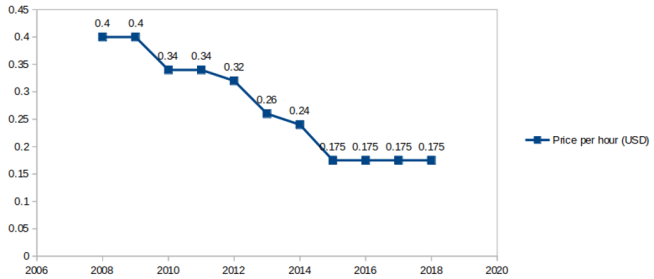
In addition, the improvement in technology infrastructure allows new services and products to be developed without spending valuable capital on building it yourself. With the advent of LTE technology and cloud computing infrastructure, companies do not have to buy or lease massive data centers to begin their first foray into product development. Pay as you go computing and dirt-cheap storage from giants like Microsoft, Amazon and Google let you configure the most powerful systems by clicking a few buttons on your browser. You don’t even have to worry about the security and maintenance of these systems. Talk about building on the shoulders of giants!

AWS cost

Fig 2 – AWS cost per hour for Linux on demand
Source – Internet Archives

Opportunities to Collaborate – Reaching out to the best in academia or industry has become so much simpler with professional and social networking platforms like LinkedIn, Facebook and Meetup that gone are my engineering days of where the email on an academic journal from 4 years ago is already abandoned because the contributor has moved on to a different organization or location. Collaborating with the best in any field is only a matter of intent and agreement and not a function of logistics or locating the right people for the job.

Easy and inexpensive access to Knowledge – Entrepreneurs who do not have the time to go through a formal college education or employers that do not have resources to re-skill themselves or their workforce do not have to be left out in the modern education landscape. What was ushered by platforms like Coursera has evolved and matured into a full-fledged online education scene where students and workforce can carry out parallel upgrades to their skills without disrupting their regular schedules. I am immensely thankful to such resources in helping me acquire a host of skills that would have taken me years to acquire through conventional classroom training. Looking at the business opportunity as well as a desire to keep themselves relevant in the changing education landscape, traditional universities like Harvard, Stanford, MIT and others have also started their own online courses independently or in collaboration with existing platforms to reach out to the masses. Companies like Google, IBM etc., very logically, have an incentive to market their products like Cloud Computing and AI frameworks and they have started online courses to teach anyone who would be interested. Want to learn how Google’s Cloud Platform works? Enrol in Coursera’s GCP fundamentals course where Google’s architects and engineers teach you how it works. Interested in learning about IBM’s Watson AI platform, why not try the Udemy course on developing AI solutions using Watson? Leave the tech. industry, you want to open a restaurant, this Masterclass course will let you learn from the legends like Thomas Keller, Gordon Ramsay, Dominique Ansel and several others. What is stopping you?

Access to world’s skilled workforce – With increasing immigration and growth of remote working opportunities enabled by better internet and video conferencing services, there is no reason for organizations to limit their talent search to the same state or even country. There was a belief that only companies with revenues in Billions of dollars can afford to be present in multiple countries and manage offshoring at profitable scales. However, today’s workforce is so scattered and diverse that it is possible to run an entirely organization virtually. Many small and medium scale companies are abandoning the idea of offices and only promote virtual offices with occasional get-togethers for team building reasons.

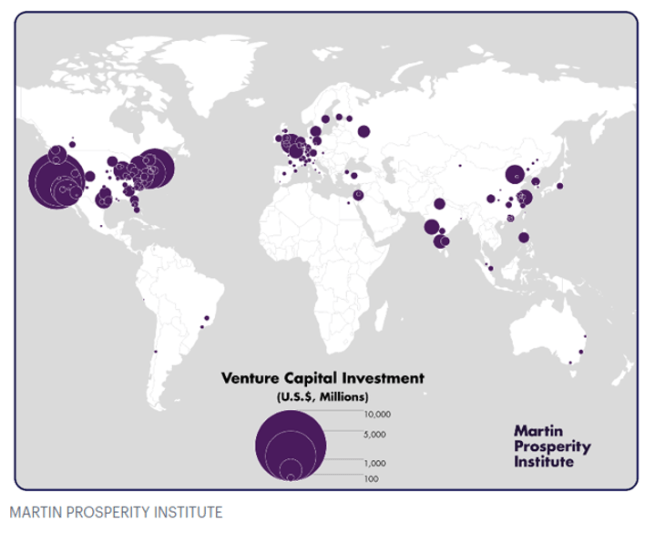
Easy Financing for Promising Ideas – Silicon Valley is no longer the only go-to place for raising money for innovative business ideas. Investors are aware of an undercurrent in several regions of the world and are paying attention to new innovation opportunities emerging from cities in China, India and Europe.

VC presence

Fig.3 – growing presence of VCs around the world

Relaxing Regulatory Framework – The significant hair loss entrepreneurs suffered by the numerous regulatory hoops that they jumped through to get their companies registered within and outside their home countries is a almost a thing of the past. Many countries, in an attempt to attract global investment and to give a boost to their economies, have drastically cut the number of bureaucratic forms that new companies need to fill in order to do business. Moreover, most of these forms are available online and entrepreneurs do not need to run from one office to another to get the necessary approvals. In an attempt to kickstart a new era of growth and foreign investments, India, for example, has reduced the number of days and forms to start a new business to only 5 each and it has plans to reduce it further.

Breaking down of social barriers – Social changes take a long time to take effect but have a transcendental impact on the progress of mankind. I am happy that we have made progress, generally in the right direction. Empowering women, increasing diversity in workplace, accessibility measures for the disabled population etc. are big goals that are not yet achieved. But there is some positive movement in these directions. I am hopeful that in the coming decade, we will have more women, minorities and disabled talent will come to the surface, after breaking the virtual barriers that have been created against them over centuries.


While putting these points, my intention was not to dismiss the problems that entrepreneurs face around the world or the hurdles that they have to overcome in order to establish an enterprise. I only want to strike a positive chord for all the budding entrepreneurs and people still on the fence who harbour a dream of changing the world. If not now, when? if not you, who?

Building effective teams

Effective teams are at the core of any organization’s success. Ask any successful leader tasked with achieving the impossible to pick the top 5 things that contributed the most to their success and chances are that they will attribute a large portion of their success to their teams. Ask the same managers about the most challenging tasks they faced in their journey and chances are they will call out their team building efforts as one of them. So, despite the widespread wisdom of the effectiveness and importance of effective teams, why is it so difficult to build one?

As a member of some very effective teams and also some not so effective ones, I struggled with this puzzle for several years. I secretly dreaded the day when I will be called upon to create a team of my own before embarking on a deal-clinching record-smashing type of endeavour. Blaming the poor team dynamics for missed targets and lost opportunities is an easy way out of an organizational quagmire for most leaders. I took mental notes on getting out of tricky situations by observing my leaders and peers, and their modus-operandi. This was before the time when I started harbouring desires of starting a small company. Owning and running the operations of my own company did not offer me the cushion of learning from my own mistakes. I had to observe and learn from the mistakes of my peers.

What follows is a distillation of some very personal and unorthodox ideas on what makes a team tick. Careful, these are not ideas to build a great team but effective teams. At this juncture, I find it important to state the difference between the two. In my humble opinion, effective teams are excellent at achieving targets and meeting goals. If you need to grow your business by venturing in new territories, you need effective teams. This team will do all the necessary market analysis, competitor research and product development to meet the deadline for a perfect launch. But if you want to put the first man on Mars or dive to the yet unexplored depths of our deepest oceans, you need a great team. Great teams are driven by something more than just goals and deadlines. They are hungry for making a mark and leaving a legacy. But more on great teams in some other post. Let’s focus on effective teams for now.

In the following paragraphs I’ve tried to be honest about my experiences in effective teams and my analysis of what worked and not. As is with most things on internet these days, I am sure that my views might not agree with several others’, but please consider this not as a commentary or critique on any previous work but my sole opinion and should be consumed as such.

  • Effective teams need effective leaders – I cannot stress enough the importance of leaders in taking teams to great heights. I believe that effective leadership is the single most important thing that makes teams achieve extraordinary results. On several occasions I have witnessed from close quarters how brilliant individual contributors flaked when led by ineffective leaders. In my most recent paid engagement with a client, a team was managed by a very under-confident and ineffective project manager. The result was that the members were perennially dissatisfied by his approach to things and could not concentrate on their work. This had a rippling effect on the team’s feedback from important stakeholders. Miraculously, when the project manager left to pursue his own ambitions, and the team came under the aegis of a better leader, the team found its confidence back. Unshackled by earlier hurdles, I saw the team quickly rise from the ashes. After over a year of mismanagement, the team was able to turn things around within 6 months and was soon in the good books of the executive leadership.
  • Diversity not just for the sake of being diverse – Diversity in teams can be a powerful factory of ideas and resources. It is difficult to over-emphasize the value and perspectives that diverse participants bring to brainstorming sessions and to the understanding of a problem. However, it is also of vital importance to not fall in the diversity trap for earning brownie points in management meetings. But is diversity only limited to parameters like race or geographical origin? In keeping with the times, organizations spend considerable resources in building diverse teams but the element of diversity is only limited to gender, race or social background. Subtler traits like education specialization, economic background, technology specialization, age groups etc. can also provide the diversity that can be a significant force in teams. Seemingly unrelated and less relevant sources of diversity can also bring new ideas that give dimensions to problems that were previously unexplored.
  • Informal structures create flexible teams – I have been a huge proponent of creating informal structures within teams from the very onset. Informal structures refer to the invisible and undocumented channels of information and power flow within the team, not restricted to the prescribed or official channels. The flow of information over lunch tables and coffee breaks cannot be replaced by email clients and collaboration platforms. The sense of ‘brotherhood’ that compels members to go the extra step to pull their brethren out of a tough one cannot be replaced by overtime and all-nighters. Creating these informal channels is the tough part and there is no one formula that works. In my experience, a lot of it flows from the top down. A rigid structure at the top and adherence to official channels by leadership will only promote adoption of formal structures. Geographically distributed teams that do not get to meet often also tend to adopt more official channels in their interactions. On the other hand, a leader that promotes informal team gatherings and uses these gatherings to disseminate information fosters growth of informal team dynamics that last longer than official structures do.

My ideas are evolving and like most things, are an interpretation of my understanding of the complex human society that has evolved over centuries. It is imperative that I will have different ideas in the future about effective teams and will keep adding to this blog. In the meanwhile, I would also like to learn from our readers on their ideas of building effective teams.