
Why is now the best time to be an entrepreneur?

New Year brings with it the usual optimism in me and despite having fared abysmally at my previous years’ resolutions, I have yet again made some new ones. While the world is seemingly embroiled in numerous conflicts and serious skirmishes, I still consider today’s world to be better than yesterdays. While the highlight of my parent’s generation was the cold war, I think one of the most defining and complex issues of my generation is the never-ending war in the middle-east, some of the less serious ones being TicTok and insufficient battery capacity of modern phones, but more on those later. None of these seem to even come close to what the world lost in the two world wars and numerous plagues and famines before them. So, my vote is with Steven Pinker when he argues that we are doing considerably better than our forefathers. In the same spirit, let me try and convince you that the best time to be an entrepreneur is now.

Unprecedented levels of trade between nations – A simple way to prove this is with official data. Let me start with that then.
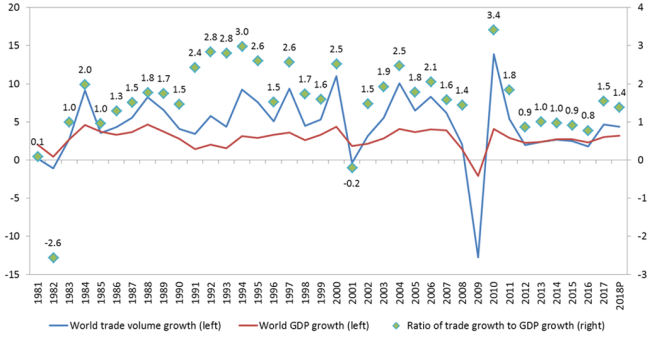
World Trade

Fig. 1 percentage change and ratio
Source – WTO and UNCTAD

World trade organization’s data shows a consistent positive growth rate of world’s trade volume. As an inference, we can confidently say that since countries are exchanging goods and services more readily, there is a bigger market for anything that today’s entrepreneurs produce than there was ever available.

Maturing technology and internet services – The pace of technology development in the last decade has brought us to the point that it is possible to design and offer products and services that were only science fiction material in the late 90’s and even early 2000’s. Things like graphical computing power that enables machine learning on several hundred million training samples in a matter of days if not hours were simply unimaginable till this decade kicked in. My humble PC at home with a modest consumer AMD chip and a mid-level NVIDIA video card lets me train a deep neural network to recognize faces on thousands of training examples in 20-30 mins. It numbs my mind because my undergrad project in the late 2000s, which was trying to teach a very rudimentary neural network to read ECG waves, took us weeks and months to achieve. My conservative guess is it would now be possible in a matter of hours on a consumer device.

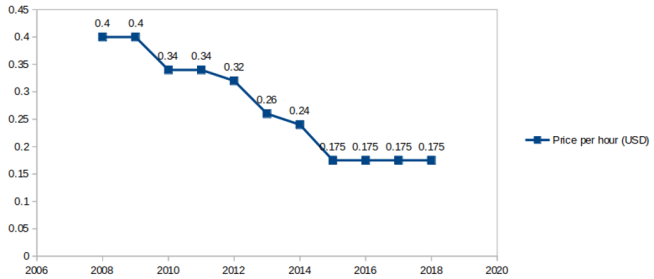
In addition, the improvement in technology infrastructure allows new services and products to be developed without spending valuable capital on building it yourself. With the advent of LTE technology and cloud computing infrastructure, companies do not have to buy or lease massive data centers to begin their first foray into product development. Pay as you go computing and dirt-cheap storage from giants like Microsoft, Amazon and Google let you configure the most powerful systems by clicking a few buttons on your browser. You don’t even have to worry about the security and maintenance of these systems. Talk about building on the shoulders of giants!
AWS cost

Fig 2 – AWS cost per hour for Linux on demand
Source – Internet Archives

Opportunities to Collaborate – Reaching out to the best in academia or industry has become so much simpler with professional and social networking platforms like LinkedIn, Facebook and Meetup that gone are my engineering days of where the email on an academic journal from 4 years ago is already abandoned because the contributor has moved on to a different organization or location. Collaborating with the best in any field is only a matter of intent and agreement and not a function of logistics or locating the right people for the job.

Easy and inexpensive access to Knowledge – Entrepreneurs who do not have the time to go through a formal college education or employers that do not have resources to re-skill themselves or their workforce do not have to be left out in the modern education landscape. What was ushered by platforms like Coursera has evolved and matured into a full-fledged online education scene where students and workforce can carry out parallel upgrades to their skills without disrupting their regular schedules. I am immensely thankful to such resources in helping me acquire a host of skills that would have taken me years to acquire through conventional classroom training. Looking at the business opportunity as well as a desire to keep themselves relevant in the changing education landscape, traditional universities like Harvard, Stanford, MIT and others have also started their own online courses independently or in collaboration with existing platforms to reach out to the masses. Companies like Google, IBM etc., very logically, have an incentive to market their products like Cloud Computing and AI frameworks and they have started online courses to teach anyone who would be interested. Want to learn how Google’s Cloud Platform works? Enrol in Coursera’s GCP fundamentals course where Google’s architects and engineers teach you how it works. Interested in learning about IBM’s Watson AI platform, why not try the Udemy course on developing AI solutions using Watson? Leave the tech. industry, you want to open a restaurant, this Masterclass course will let you learn from the legends like Thomas Keller, Gordon Ramsay, Dominique Ansel and several others. What is stopping you?

Access to world’s skilled workforce – With increasing immigration and growth of remote working opportunities enabled by better internet and video conferencing services, there is no reason for organizations to limit their talent search to the same state or even country. There was a belief that only companies with revenues in Billions of dollars can afford to be present in multiple countries and manage offshoring at profitable scales. However, today’s workforce is so scattered and diverse that it is possible to run an entirely organization virtually. Many small and medium scale companies are abandoning the idea of offices and only promote virtual offices with occasional get-togethers for team building reasons.

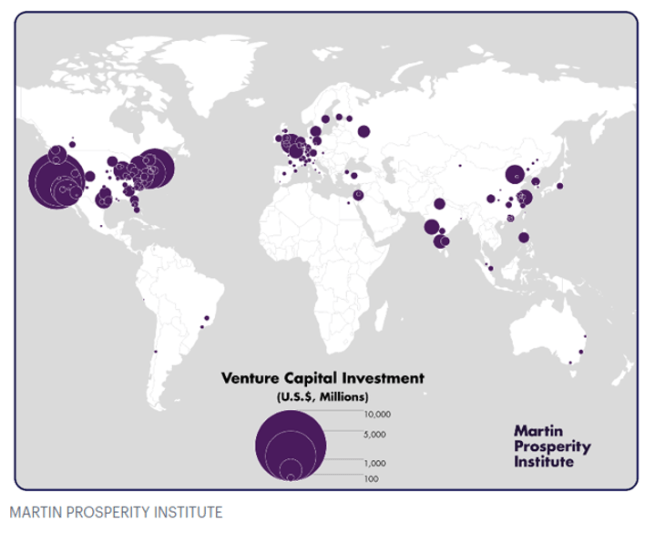
Easy Financing for Promising Ideas – Silicon Valley is no longer the only go-to place for raising money for innovative business ideas. Investors are aware of an undercurrent in several regions of the world and are paying attention to new innovation opportunities emerging from cities in China, India and Europe.
VC presence

Fig.3 – growing presence of VCs around the world

Relaxing Regulatory Framework – The significant hair loss entrepreneurs suffered by the numerous regulatory hoops that they jumped through to get their companies registered within and outside their home countries is a almost a thing of the past. Many countries, in an attempt to attract global investment and to give a boost to their economies, have drastically cut the number of bureaucratic forms that new companies need to fill in order to do business. Moreover, most of these forms are available online and entrepreneurs do not need to run from one office to another to get the necessary approvals. In an attempt to kickstart a new era of growth and foreign investments, India, for example, has reduced the number of days and forms to start a new business to only 5 each and it has plans to reduce it further.

Breaking down of social barriers – Social changes take a long time to take effect but have a transcendental impact on the progress of mankind. I am happy that we have made progress, generally in the right direction. Empowering women, increasing diversity in workplace, accessibility measures for the disabled population etc. are big goals that are not yet achieved. But there is some positive movement in these directions. I am hopeful that in the coming decade, we will have more women, minorities and disabled talent will come to the surface, after breaking the virtual barriers that have been created against them over centuries.


While putting these points, my intention was not to dismiss the problems that entrepreneurs face around the world or the hurdles that they have to overcome in order to establish an enterprise. I only want to strike a positive chord for all the budding entrepreneurs and people still on the fence who harbour a dream of changing the world. If not now, when? if not you, who?

What does AI mean for Insurers

From Vicky, the humanoid in 90’s kids show Small Wonder to Ava, the sentient, Turing test cracking and starkly human looking robot in Ex-Machina, we have always fantasized a world with Artificially Intelligent computers. While the former example was a lighter take on what AI could look like in everyday world, the latter was a more serious attempt to rethink the same concept. But between these two stark contrasts, AI is being effectively used by businesses today to perform several tasks that would have required humans to sweat tirelessly for weeks and sometimes even months.

On a high level, the term Artificially Intelligent can be attributed to any computer or machine that replicates a human behavior. With that broad a definition, even an IVR system is intelligent. After all it tries to do what a human would have done i.e. try to ascertain the purpose of your call and connect you to the right department. However, given the advances that the field has made in the last decade and for the purpose of this article, I will refrain from using such a broad brush to paint the industry practices. The widely accepted and more refined definition of artificial intelligence goes as below.

A system’s ability to correctly interpret external data, to learn from such data, and to use those learnings to achieve specific goals and tasks through flexible adaptation.

An average Joe’s life is surrounded by intelligent machines. For example, the YouTube recommendations that pull you into a never-ending spiral of binge that by the time you look at the clock it is already 3am or the innocuous spam filter in your email that quietly works in the background without you ever noticing it. More complex AI algorithms are being employed by businesses to predict stock movements, presence of cancer, real time face recognition etc.

While other businesses have made significant advances in adopting AI in everyday tasks, the insurance industry is still seriously lagging behind in making any meaningful mark in the discipline. In my modest 7 years experience working for large insurers, I have not come across any path breaking implementation of machine learning, deep neural networks or other relevant concepts in real life. Some carriers have realized that they are late to the party and hence are rushing to acquire the necessary skills and teams to build a data analytics and AI practice but their progress is still in nascent stages. Lack of a holistic strategy is what keeps the players from making game changing progress, something that AI is absolutely capable of delivering.

I have tried to list some use cases that are radical but totally worth exploring for establishing the next generation of Insurance products and services.

  • Custom risk assessment for accurate underwriting – Since the early days of life insurance, most insurance companies have relied on four parameters for a customer’s risk assessment – Age, Gender, Smoker Status and Occupation. These parameters determine your basic mortality risk, which is sometimes peppered with a few more historical parameters like a health assessment and lifestyle preferences questionnaire. In our opinion, these methods of determining insurance risk is outdated and needs a massive overhaul. Life insurance risk assessment can incorporate so many relevant data points available from wearable devices, lifestyle expenditure patterns and social media feeds for a more accurate and customized profile. Just because I am a 40 years old smoker who works in sales doesn’t mean that the level of risk I pose is the same as another 40 year smoker salesman who regularly runs half marathons, shops at organic stores and is a regular at his gym.
  • Remote surveillance after a natural disaster – Imagine the plight of property owners who have been hit by a massive hurricane like Dorian or Katrina. In the midst of all the chaos and loss suffered by the owners, they also have to deal with insurance providers who are not able to reach the premises due to infrastructure collapse. It takes weeks and sometimes even months to get the infrastructure up and running before any kind of inspection can be performed on the property. Some insurers have started using aerial drone footage to do preliminary assessment of the destruction, but it is still limited to mostly manual identification of broken roofs and fallen trees. Deep neural networks are capable enough to identify damaged houses, vehicles, swimming pools
  • Intelligent telematics – several insurers have started to invest in solutions and devices that allow them to monitor customer’s driving styles. Though most of these programs are in nascent stages, their fundamental premise is far from leveraging the true capabilities of intelligent telematics. My auto current insurer offers a ‘program’, which when enrolled in, gives me 5% discount on my insurance premium and also rates me on my driving every time I take out my car. However, the system is far from being ‘intelligent’ as the insurer claims it to be. I understand the ‘under-the-hood’ working algorithm that powers the program. Rather than assessing my driving style and marrying it with the driving context, the program only uses an algebraic formula to give me points on my speed, cornering, acceleration and breaking. The cumulative score I get for every driving session reflects the discount that I will be entitled to at the end of the year. Instead of such half-baked algebraic telematics, the new age object recognizing algorithms that power self-driving vehicles can be used to better assess a driver on the road. Things like how long after the front car’s break light went off did the driver apply breaks is a far better representative of the risk drivers pose than a driver doing 5 kmph on a highway.
  • Intelligent digital assistant – An insurer provided digital assistant, akin to Google’s assistant or Apple’s Siri, can smoothen out many kinks in customer interactions for which they have to call the contact center. Simple pieces of information like my next premium due date or tasks like updating my address should not require me to pull out my policy documents that are lying in a pile in storage or call a contact center, only to be put on hold for 30 min (true story). Add to that the fact that most life insurance policies require customers to make payments once a year, makes it even more unlikely that customers will reach out. No wonder, majority of adults do not relate with their carriers in the same way they relate to other e-commerce partners like Uber or Amazon. An intelligent digital assistant that is available 24×7 and is intelligent enough to answer basic financial questions will make the customers feel connected with the carriers. Empowering the customers with technology will not only result in a recurring relationship but also impact the bottom line of the company.
  • Pay as you use insurance – Life, auto and several other types of insurance are typically renewed after a certain period of time. My life insurance contract is renewed every year when I pay my premiums and my car insurance every 6 months. It doesn’t matter if my car spent 2 months in winter sitting in my garage because I prefer to take an Uber when it snows. I still pay the same amount of premium for my car insurance. On the other extreme, it doesn’t matter if I suddenly decide to take a long road trip across the country to see my college friends. Though futuristic, usage-based insurance products are possible with the amount of data and connected devices that are available. Insurers can develop, with the amount of data that is available with them, models to accurately predict increase or decrease in risks for departure from regular trends in customers’ lives.

I have been working with Insurers for the better part of the last decade and have seen a recent uptick in technology exploration and adoption. A lot of my clients have shown interest in building an AI lab that gives them immediate result on the balance sheet. My recommendations to all my clients have been the same – AI is not something that you can install in a year or two and keep upgrading every 6 months thereafter. It is a continuous journey that requires a fundamental overhaul of how we perceive data, leverage it and keep improving our models for better accuracy and relevance.